June Book of the Month
Tuesday, June 24, 2008
Sneak Preview
June Book of the Month
Thursday, June 19, 2008
N199AB to Travis
June 18, 2008
Here is the latest information we have on the delivery of the Alaskan C-133 to Travis Air Force Base.
Travis Air Museum will be receiving the C-133 from Alaska along with two additional C-133s from the Mojave Desert. The plans are to have the one from Alaska arrive at Travis during the Air Force Celebration over the Labor Day Weekend.
The two that Travis will receive from the Mojave are not flyable and will be used for spare parts. There are plans to remove the fight deck from one of them and install it inside the museum. The museum hopes to involve former crew members in this project (more information on this when it becomes available).
The biggest challenge the museum has at the present time is the fuel purchase to fly the plane from Alaska to Travis. [Cal comment: 18,000 gallons for unpressurized flight of 7:55 plus reserves will cost about $108,000].
The museum has received a donation of $5,000.00 from a former C-133 crew member. This member is challenging other former members for donations, up to an additional $5,000.00, which he will match.
So many of you have asked how you can help. To make your donation, please send a check or money order to:
C-133 PROJECT
TRAVIS AIR MUSEUM
400 BRENNAN CIRCLE
TRAVIS AIR FORCE BASE, CA 94535
Those who donate $250.00 or more will have their name placed on a donation plaque in the C-133 area of the museum.
Terry Juran from the Travis Museum will be in Alaska next week to inspect the
C-133 and we are hoping to post pictures on this site when he returns.
Spread the word and please send any questions to us:
John and Jetta Burnett
Jnburnet@cwnet.com
Friday, June 6, 2008
Fuel Burn
Put on your engineer's cap for a minute and give me some round figures ( I figure you don't even need the Dash One Dash One to do this). The big ticket item to get N199AB from Anchorage to Travis is fuel.
Let me know at firstfleet@aol.com.
I want to see if any fund-raising is an option.
Cal Taylor
Wednesday, June 4, 2008
Emer Procedures Tng Film
"He flew the C-133 for a number of years.
What: 16 mm training film titled "Emergency Procedures for the C-133A"
Who: U.S. Air Force Photo Mapping Squadron, which at the time operated out of Orlando
Where: I hope you can tell me...
When: Filmed in 1961 or 1962 and distributed for some years thereafter "
Tim says he has had no luck in AF channels, so hopes a private party might be the key.
Anyone out there who might have or know where to find this or any other C-133 training film. Traditions has only a couple, just of the roll-out and arrival at Dover.
Cal Taylor
Tuesday, June 3, 2008
N199AB/61999 Update
Cal Taylor
Friday, May 23, 2008
SR-71 Blackbird
The SR-71 in the first photo below is in the National Museum of the Air Force, Wright-Patterson AFB, Dayton, Ohio. This particular plane flew the first operational mission, and has the most operational time of any SR in the fleet.

In April 1986, following an attack on American soldiers in a Berlin disco, President Reagan ordered the bombing of Muammar Qaddafi's terrorist camps in Libya. My duty was to fly over Libya and take photos recording the damage our F-111's had inflicted. Qaddafi had established a 'line of death,' territorial marking across the Gulf of Sidra , swearing to shoot down any intruder that crossed the boundary. On the morning of April 15, I rocketed past the line at 2,125 mph.
I was piloting the SR-71 spy plane, the world's fastest jet, accompanied by Maj Walter Watson, the aircraft's reconnaissance systems officer (RSO). We had crossed into Libya and were approaching our final turn over the bleak desert landscape when Walter informed me that he was receivi ng missile launch signals. I quickly increased our speed, calculating the time it would take for the weapons-most likely SA-2 and SA-4 surface-to-air missiles capable of Mach 5 - to reach our altitude. I estimated that we could beat the rocket-powered missiles to the turn and stayed our course, betting our lives on the plane's performance.
After several agonizingly long seconds, we made the turn and blasted toward the Mediterranean . 'You might want to pull it back,' Walter suggested. It was then that I noticed I still had the throttles full forward. The plane was flying a mile every 1.6 seconds, well above our Mach 3.2 limit. It was the fastest we would ever fly. I pulled the throttles to idle just south of Sicily , but we still overran the refueling tanker awaiting us over Gibraltar.
Scores of significant aircraft have been produced in the 100 years of flight, following the achievements of the Wright brothers, which we celebrate in December. Aircraft such as the Boeing 707, the F-86 Sabre Jet, and the P-51 Mustang are among the important machines that have flown our skies. But the SR-71, also known as the Blackbird, stands alone as a significant contributor to Cold War victory and as the fastest plane ever-and only 93 Air Force pilots ever steered the 'sled,' as we called our aircraft.
The plane was dripping, much like the misshapen model I had assembled in my youth. Fuel was seeping through the joints, raining down on the hangar floor. At Mach 3, the plane would expand several inches because of the severe temperature, which could heat the leading edge of the wing to 1,100 degrees. To prevent cracking, expansion joints had been built into the plane Sealant resembling rubber glue covered the seams, but when the plane was subsonic, fuel would leak through the joints.
In 1962, the first Blackbird successfully flew, and in 1966, the same year I graduated from high school, the Air Force began flying operational SR-71 missions.
The SR-71 was the brainchild of Kelly Johnson, the famed Lockheed designer who created the P-38, the F-104 Starfighter, and the U-2. After the Soviets shot down Gary Powers' U-2 in 1960, Johnson began to develop an aircraft that would fly three miles higher and five times faster than the spy plane-and still be capable of photographing your license plate.
The SR-71 was an expensive aircraft to operate. The most significant cost was tanker support, and in 1990, confronted with budget cutbacks, the Air Force retired the SR-71. The Blackbird had outrun nearly 4,000 missiles, not once taking a scratch from enemy fire.
On her final flight, the Blackbird, destined for the Smithsonian National Air and Space Museum , sped from Los Angeles to Washington in 64 minutes, averaging 2,145 mph and setting four speed records.
The SR-71 served six presidents, protecting America for a quarter of a century. Unbeknownst to most of the country, the plane flew over North Vietnam , Red China, North Korea , the Middle East, South Africa , Cuba , Nicaragua , Iran , Libya , and the Falkland Islands. On a weekly basis, the SR-71 kept watch over every Soviet nuclear submarine and mobile missile site, and all of their troop movements. It was a key factor in winning the Cold War.
I am proud to say I flew about 500 hours in this aircraft. She defeated every missile, outran every MiG, and always brought us home. In the first 100 years of manned flight, no aircraft was more remarkable.Author Unknown
Thursday, May 22, 2008
C-133 Replacement
Monday, May 19, 2008
Ed Elias, 1972 POW
ELIAS, EDWARD KNIGHT
Rank/Branch: 04/US Air Force
Unit:
Date of Birth:
Home City of Record:
Date of Loss: 20 April 1972
Country of Loss: North Vietnam
Loss Coordinates: 172400N 1063400E
Status (in 1973): Released POW
Category:
Aircraft: RF4C
Other Personnel in Incident: None missing
Source: Compiled by P.O.W. NETWORK 06 September 1996 from one or more of the following: Raw data from U.S. Government agency sources, correspondence with POW/MIA families, published sources, interviews.
REMARKS: Released Hanoi 720925
VIETNAM [magazine]: June 1996
PERSONALITY:
In a bizarre incident, Air Force POW Ed Elias was freed through the
propaganda efforts of American collaborators.
By Carole Hack
Major Ed Elias was captured three days after he and his backseater ejected from their burning McDonnell F-4C fighter over North Vietnam. Although Elias evaded one surface-to-air missile (SAM), a second hit them.
Elias saw no one the first day. The second day, searchers came very close to him. On the third day, he decidded to leave his secure hiding place and move across the river, to get away from the populated area and establish communications. He was captured near the river later that afternoon by North Vietnamese Army (NVA) troops. "If you're going to be captured," Elias said, "you're better off with regular army that understands the importance of an American prisoner."
After the NVA soldiers stripped and searched him, they gave him back his flight suit, but not his boots. They marched Elias out with tied wrists. After they were out of the jungle, they blindfolded him. He lay down in a truck and rode about 30 minutes to a holding area, where they interrogated him.
At one place, the captors stopped and displayed their prisoner to the local people. Some of the locals poked at him with sticks. One guard tried to push them away, but they persisted. To Elias' relief the soldiers reappeared and left with him in tow.
At one point on the journey, Elias' captors stopped on the road and told him to dig a hole. A car pulled up bearing an officer and a civilian with a camera, who took a picture of Elias. The photo was later published in a newspaper with a caption saying this was an American digging a foxhole to protect himself from American bombing attacks. Elias was told he was digging his own grave.
His guards were singing Ho Chi Minh songs and Hanoi was ablaze with lights as Elias entered the city in the evening, 3 1/2 days after his capture. That was a low point for him. He could not believe the city was lit up, rather than hiding in fearful darkness.
Elias was taken to Hao Lao, the old French prison known to its inhabitants as the "Hanoi Hilton." First stop was "New Guy City."
The people most likely to have current military information were "the new guys," the new prisoners, said Elias. The American military knew U.S. fliers could be shot down, so they changed military information all the time. While new prisoners were subjected to intense interrogation, the captors eventually moved on to things that could be used for propaganda purposes.
For the first week, Elias was interrogated day and night. They tied him up, threatened him, said they would release evidence to show he had been killed, kept him awake, and generally wore down his endurance. Since his capture, he had been interrogated by Russians, Eastern Europeans, a Cuban, and a Vietnamese with a French accent.
New Guy City was all solitary confinement. Elias was first confined to a big room, about 20 by 20 feet. On the high ceiling was a loudspeaker and a light that was always on. The walls were plaster over lath. The floors were stone. In the center was a concrete pedestal two feet off the floor that served as a bed. There was a door with bars on the window. After a week, Elias' captors left him alone for awhile. He was then moved to a smaller room in New Guy City. After four months, he was taken to another camp, name CuLoc, "The Zoo." It was a former French movie studio converted to a prison. There, rooms were about 10 by 5 feet with a concrete pedestal in the middle and a bamboo mat. A mosquito net was a welcome addition because it protected him from rats as well as from mosquitos.
Prisoners at the Zoo were fed twice a day. In the morning they got a cup of powdered milk and a piece of bread. The bread was dotted with pink spots, with a weevil in the center of each pink spot. Some prisoners picked out the weeils, but Elias ate the bread, weevels and all, because it supplied more protein. The second meal was served around 4 p.m. It was soup made from local vegetables in season. This could be turnip greens, pumpkins, potatoes, or squash. Sometimes there was pig fat in it, with the hair still on the skin side of the pig.
The prisoners wore clothing that was either maroon or gray striped. Shoes were thong sandals made from old tires. Toilet facilities were a bucket. The sandals could be set on the rim to serve as a seat.
Although the prisoners could not see one another, their routines were such that when one prisoner was led off to a weekly four-minute bath at a well, another prisoner would empty the absent prisoner's bucketl. Sometimes this routine offered an opportunity to leave a message scratched on a piece of soap or paper. The prisoners called them "drops."
Another form of communication was tap code. Prisoners memorized the alphabet in the form of a grid, with each letter having a number equivalent that was determined by its position on the grid. Then they tapped out a message. The Vietnamese knew the code too, but they couldn't have someone listening in every cell all the time.
The best time to communicate was in the midst of confusion. The guards were frightened by bombing raids and would hide until the all-clear. During such times, the prisoners would yell to one another.
Elias kept his eye on the piece of sky in his window at The Zoo. One dahy he saw an airplane shot down. He established the date. (Guards who spoke English were willing to tell prisoners the date.) Years later, he learned the downed pilot had escaped. Unless another pilot was shot down on the same date, the pilot was Bud Breckner, who later would be Elias' wing commander at Williams Air Force Base.
One day Elias was blindfolded and put in a vehicle with another blindfolded American, Jim Padgett. They were taken into a room and seated at a table; their blindfolds removed. They saw five or six other prisoners sitting there, Minutes later, in walked Jane Fonda.
She talked 30 to 45 minutes about why she came to North Vietnam. She stood in front of the men and lectured them about committing genocide, destroying civilian targets and committing other atrocities. Fonda said she would be broadcasting a message asking their fellow American fliers to refuse to fly sorties against North Vietnam. She dwelt on how much the people of the United States were against the war.
Later, Elias listened to what he thinks was a tape of the same speech broadcast over the loudspeaker in his cell.
Elias was not taken to hear former Attorney General Ramsey Clark speak, but once again tapes were played over the loudspeaker in his cell. Clark said how wrong the United States' actions were in the eyes of international law.
Those experiences were a low point in Elias' entire POW experience. He threw his sandals at the loudspeaker again and again in his cage.
"We were really pumped up for the cause," he recalled. "We wanted South Vietnam to have the right to be free. Here these Americans were coming over and telling us we were criminals."
One night someone came to Elias' cell and told him to put on his clothes and come along. Elias was taken to the interrogation room, where another man was sitting. "Some Americans are coming to see us," the man said. After the two men had sat there for a long time, an interrogator, who had been nicknamed "the Weasel" while at the Hanoi Hilton, appeared. He told them, "In honor of [some Vietnam holiday] and the benevolence and memory of our beloved president and the goodwill of the American people, we are going to release some prisoners." After that, Elias was returned to his cell. He was called back again the next day, and the release progressed from there.
The actual circumstances of Elias' release were a mystery to him at the time. The people who came to release him referred to themselves as "the Coalition." They included Cora Weis of the Faberge' family; David Dellinger of the Chicago Seven; William Sloan Coffin, a Yale University chaplain; and Professosr Richard Falk. They were accompanied by NBC correspondent John Hart and Associated Press correspondent Peter Arnett. Elias says the whole thing was a propaganda effort to show that the Coalition could deal with the North Vietnamese government and the American government could not.
"I didn't know who these people were," he said. "I only knew I wanted to get back to the military." When he learned the Coalition was intent on preventing the military from "capturing" him, he got up from their table and left the room. A North Vietnamese political officer stopped him and said, "That is not intelligent."
Elias and the Coalition flew from Hanoi to Beijing. Arnett had given Elias the telephone number of the satellite communication system that President Richard Nixon had used on his recent trip to China. When Elias walked into his hotel room, he picked up the telephone and dialed that number. A switch operator picked up the call in New York and passed it through to Elias' wife in Valdosta, Ga. "We talked no more than two minutes," Elias said. "no one eger knew except Peter Arnett, who was in the room when I called."
From Beijing the group flew to Moscow where Adolph "Spike" Dubbs was the American charge'd'affaires. Elias said, "He was wonderful." After a conversation with Dubbs, Elias decided to be quiet. The group flew fromm Moscow to Copenhagen and then on to New York, where Elias was finally reunited with his wife and family.
[Disributed through P.O.W. NETWORK]
Tuesday, April 29, 2008
April Book of the Month
By
John J. Pershing
Commander-in-Chief, American Expeditionary Forces
Dedicated to The Unknown Soldier
John J. ’Black Jack’ Pershing, 1860-1948, was one of America’s most famous Army officers known world wide for his untiring energy, faithfulness, and gallantry. His extraordinary personal efforts during WWI of insisting that America field its own Army with its own command structure rather than augmenting ally troops set the stage for America to become a world power during the 20th century. However, the warnings Pershing implored in Experiences about being ill prepared to meet aggression were largely ignored in the lead up to WWII. Some still feel we have not fully integrated that simple but critical aspect of national survival into our cultural ethos.
Pershing thus becomes another example in a long line of our citizens from ordinary circumstances who stepped forth upon the international stage in time of need. He graduated from West Point in 1886 and was appointed the overall American Commander in Europe during WWI. General Pershing ended his career as Army Chief of Staff retiring in 1924 fully recognized as a heroic and fearless warrior in defense of our Country.
Thousands of adoring American citizens, many ‘his doughboys’, along with numerous foreign dignitaries attended Pershing’s 1948 funeral service. Pershing is buried at Arlington National Cemetery along with his two grandsons, 2Lt. R.W. Pershing and Col. J.W. Pershing. General Pershing’s wife, Helen Frances Warren, and three daughters died in a tragic fire that destroyed the quarters at the Presidio of San Francisco August 1915 with only his son, Warren, surviving.
For Pershing to carry on with the burden of his professional duties after such a life-wrenching event speaks to the greatness of this man. But, carry on he did leading the American fighting forces to victory during WWI: the ‘War to End all Wars’. As his memoirs, My Experiences in the World War cover only WWI; the following is a short web based biography of Pershing’s full Army experience and personal life that is informative and fascinating. Click on: Arlington National Cemetery Website.
| John Joseph Pershing | |
|---|---|
| September 13, 1860(1860-09-13) – July 15, 1948 (aged 87) | |
Published in 1931 General Pershing’s primary purpose in writing Experiences, the story of the American Expeditionary Forces in France, was to convey the many timeless lessons should the Country ever be called to arms again. WWI found us absorbed in the pursuits of peace and listening to no warnings of danger about the coming European conflagration. During the early part of the 20th century, Congress had authorized limited preparations for defense but none for aggression. Thus, it took years for the Country to change its habits in order to meet the realities of modern military combat in Europe.
Those lessons Pershing warned about were again largely unheeded during the 1920’s and 30’s in the lead up to WWII as they have been for other conflicts that America has entered. However, since 1945 the people of the United States have been constantly engaged in the level of preparedness it feels it needs to meet its obligation to ensure our personal and economic freedoms. The present internal political conflict regarding terrorism is an example of such debate and the lessons that Pershing warns are again in question. Can we change the very habits of our lives to meet the realities of Non-nation, long term, domestic and international aggression that we are now confronting?
The importance of Pershing’s contributions to America’s prominent position in world affairs today was profound. They are largely the result of his activities in Europe beginning in 1917 where he firmly insisted upon an independent American Army. France and England both wanted American troops to be divided among their armies feeling America’s contribution to the Great War was to be men and material rather than an independent fighting force. Pershing would have none of that.
Adding to Pershing’s stature of national importance concerning the U.S. becoming a world power was his insistence upon rigid combat troop training in the US before embarking for Europe. The methods for military training that Pershing began in 1917 were the foundation for the mobilization of WWII that produced the finest, most far-flung military force the world had ever seen. Those same concepts of an independent American fighting force with its own Commander undergoing disciplined training are still a major asset of our military and its ability to attract recruits. The professionalism of our citizen military has made it today’s most trusted and respected of all government institutions.
It is truly unbelievable how dismally unprepared America was to face modern warfare at the time. Here was the situation for Army aviation. The Air Service Section of the Signal Corps consisted of 65 officers and about 1,000 men. There were 35 officers who could fly and only about 5 of those could meet the requirements of the then modern battle conditions. None had any technical experience with aircraft guns, bombs, or bombing devices. The Corps had 55 training planes all without war equipment; of the 55 planes, 51 were obsolete and the other four obsolescent; the Corps could not put a single squadron in the field. It was estimated that we would eventually need 300 squadrons each with an average of 24 officers, 180 men, and 18 airplanes. The Army, Navy, and Marines, were all facing the same deplorable operational readiness conditions.
Pershing’s memoirs in My Experiences in the World War also recognizes the remarkable efforts of the American people, the soldiers, and his General Staff in meeting the needs of a modern war that included thousands of horses needing care, thousands of motorized vehicles needing maintenance, and thousands of men to be trained for combat. In addition, much of the infrastructure in France and Britain had to be rebuilt to accommodate the influx of the American Army. It is because of Pershing’s efforts in coalescing America and the free world in an ultimate victory during this tragic era of the first modern world war that he was so revered by his troops and our allies. He was a ‘larger than life’ figure for those who knew him, for those who served under him, and for those who became free because of him. Their dedication to him was above all reproach.
Experiences will be especially interesting to C-133 crewmembers as a large portion is dedicated to the flying forces at the time. The training, planes, airfields, navigation, and other operational tasks were shockingly primitive compared to the 1960’s and archaic in today’s world of the USAF. This revealing memoir published by Pershing about the American military world of the early 20th century and its need to engage on an international front set the stage for our modern force structure. The C-133 was a small but important part of that continuum leading to America’s rise to this present period of preeminence as the world’s only superpower.
During The War to End All Wars America suffered 53,513 hostile deaths, 204,002 wounded, and 63,195 non-hostile deaths caused mostly by the flu epidemic that swept through Army camps in 1918. Kansas City, MO, hosts Liberty Memorial that is noted as probably the most outstanding monument to WWI veterans in the nation. Its museum is the only one in the U.S. specializing in the WWI period. Experiences is well worth reading as General Pershing guides us through a historical time of change for our military forces and our Country. Enjoy!
39th ATS , DAFB, 1962-1965
Sunday, April 27, 2008
Busted Fly-Over
http://www.youtube.com/watch?v=tDkCVmWov5U
Submitted by Sandy Sandstrom
Saturday, April 26, 2008
Sneak Preview
April Book of the Month
| John Joseph Pershing | |
|---|---|
| September 13, 1860(1860-09-13) – July 15, 1948 (aged 87) | |
| Nickname | Black Jack |
Monday, April 21, 2008
Saturday, April 19, 2008
When the Music Stopped
I recently attended a showing of 'Superman 3,' here at LSA Anaconda. We have a large auditorium we use for movies, as well as memorial services and other large gatherings. As is the custom back in the States, we stood and snapped to attention when the National Anthem began before the main feature.
All was going as planned until about three-quarters of the way through The National Anthem the music stopped. Now, what would happen if this occurred with 1,000 18-22 year-olds back in the States? I imagine there would be hoots, catcalls, laughter, a few rude comments; and everyone would sit down and call for a movie. Of course, that is, if they had stood for the National Anthem in the first place.
Here, the 1,000 Soldiers continued to stand at attention, eyes fixed forward. The music started again. The Soldiers continued to quietly stand at attention. And again, at the same point, the music stopped. What would you expect to happen? Even here I would imagine laughter, as everyone finally sat down and expected the movie to start. But here, you could have heard a pin drop. Every Soldier continued to stand at attention. Suddenly there was a lone voice, then a dozen, and quickly the room was filled with the voices of a thousand soldiers, finishing where the recording left off: “And the rockets red glare, the bombs bursting in air, gave proof through the night that our flag was still there. Oh, say does that Star-Spangled Banner yet wave, o'er the land of the free, and the home of the brave?”
It was the most inspiring moment I have had here in Iraq. I wanted you to know what kind of Soldiers are serving you here. Remember them as they fight for you! Pass this along as a reminder to others to be ever in prayer for all our soldiers serving us here at home and abroad. For many have already paid the ultimate price.
Written by Chaplain Jim Higgins
LSA Anaconda is at the Ballad Airport in Iraq, north of Baghdad
Provided by Sandy Sandstrom
Friday, April 18, 2008
Thursday, April 17, 2008
How Do You Spell "Assume?"
Arriving at the airfield, he spotted a plane warming up outside a hanger. He jumped in with his bag, slammed the door shut, and shouted, 'Let's go'.
The pilot taxied out, swung the plane into the wind and took off.
Once in the air, the photographer instructed the pilot, 'Fly over the valley and make low passes so I can take pictures of the fires on the hillsides.'
'Why?' asked the pilot.
The pilot was strangely silent for a moment,
finally he stammered, 'So, what you're telling me, is . .. you're NOT my flight instructor?'
Submitted by Bob Becht, Pilot, 1st ATS, '61-'65
Sunday, April 13, 2008
First Anniversary Reminder
Another great resource is the Related Websites section on the lower right side of the blog. There you'll find a list of Hot Links to many (currently 17) other sites regarding 133 relevant History, AFBs, Museums, Models, etc. Probably the most interesting is Cal Taylor's Book website (Remembering an Unsung Giant) which provides a wealth of information about the original C-133 Project at Douglas Aircraft Company, Mission, Accidents, Tail Numbers, Tech Data, Units, Gallery, still more links, and a Guest Book Sign-in.
And we eagerly solicit your Comments (easy to add after any Post) and suggestions for new interest and information. Please help us keep it "alive!"
Saturday, April 12, 2008
Thursday, April 10, 2008
Painted Beaver Tail Photos
And again, thanks to Harry Heist for these pictures, and Erich Hausner, who was responsible for getting the blueprints from Boeing so the tail could be made. He got them from the lady in charge of the library, and a retired engineer volunteer who dug them out of the archives.
Wednesday, April 9, 2008
World's Largest R/C Airplane
http://www.youtube.com/watch?v=KmKdA6L_MWk
Tuesday, April 8, 2008
Pilot Philosophy
The duck can fly.
A check ride ought to be like a skirt.
Short enough to be interesting, but long enough to cover everything.
Speed is life.
Altitude is life insurance.
It only takes two things to fly:
Airspeed, and money.
The three most dangerous things in aviation:
1. A Doctor or Dentist in a Cessna.
2. Two captains in a DC-9.
3. A flight attendant with a chipped tooth.
Aircraft Identification:
If it's ugly, it's British.
If it's weird, it's French.
If it's ugly and weird, it's Russian.
Without ammunition, the USAF would be just another very expensive flying club.
The three best things in life are a good landing, a good orgasm, and a good bowel movement.
A night carrier landing is one of the few opportunities to experience all three at the same time.
The similarity between air traffic controllers and pilots?
If a pilot screws up, the pilot dies.
If ATC screws up, the pilot dies.
It's better to break ground and head into the wind than to break wind and head into the ground.
The difference between flight attendants and jet engines is that the engines usually quit whining when they get to the gate.
New FAA motto:
'We're not happy, till you're not happy.'
If something hasn't broken on your helicopter--it's about to.
Basic Flying Rules:
1. Try to stay in the middle of the air.
2. Do not go near the edges of it.
3. The edges of the air can be recognized by the appearance of ground, buildings, sea, trees and interstellar space. It is much more difficult to fly in the edges.
Unknown landing signal officer to carrier pilot after his 6th unsuccessful landing attempt: 'You've got to land here son. This is where the food is.'
Monday, April 7, 2008
Carrier Landing
Thanks to Gulfstream (and former Army) pilot, Bob Ozbolt, for text & video!
Wednesday, March 26, 2008
March Book of the Month
of
Ulysses S. Grant
by
Ulysses Simpson Grant
(1822-1885) 
“Man proposes and God disposes. There are but few important events in the affairs of men brought about by their own choice” and thus begins the Personal Memoirs of U. S. Grant.
His Memoirs have been widely recognized as the best, most noble, and most stately work set down by an American public figure. He did not write to defend his actions as General or President or to attack old enemies. He wrote what he experienced, what he did, why he did it, and has left the second-guessing to historians. Grant’s Memoirs are considered the gold standard; a model much revered but seldom emulated by current political figures.
A brief profile of Grant would include him as a Mayflower descendent, a West Point Graduate, the first General of the Army of the United States, and the 18th President serving two terms. The family was American for generations in all its branches, direct and collateral. His distinguished attributes and achievements involved a great deal of personal skill and talent as both a soldier and a politician. Grant had a take-charge personality formed during his early life in Georgetown, Ohio, where he remained until leaving for West Point in May 1839.
Upon entering West Point a military life had no charm for him and he did not expect to stay in the army; and, because of poor academic preparation he did not expect to graduate. During his first year General Scott visited West Point to review the troops and Grant noted in his Memoirs, “…I believe I did have a presentment for a moment that someday I should occupy his place on review….” Getting to that place was not easy as it has not been for those who have followed.
While reading Grant’s Memoirs one is constantly struck by the honesty he conveys to the reader. He states there must be many errors of omission because the subject is so large to be treated in such a way to do justice to all the soldiers engaged. In preparing the work for the public he, ”…entered upon the task with the sincere desire to avoid injustice to any one… other than the unavoidable injustice …where special mention is due….” All agree that he wrote without prejudice or harm to friend or foe.
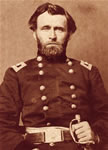
![]()
One of only a few known photographs of Grant with a sword.
Grant was involved in two major conflicts during his Army career, the Mexican and the Civil Wars. It is just stunning to read the detail of these engagements written from his personal memory some years after their endings. The richness is mesmerizing; it is as if you are listening to him reciting a great and epic poem from an era gone by. The stories of the men, the engagements, the terrain, the causes, the bravery, and the responsibility are all vividly addressed.
The logistics needed to fight these Wars seem over whelming given the ease of modern day transportation. It is difficult to comprehend the movement of thousands of men and thousands of horses by river or through impenetrable swamps. The feel of early America and the wilderness of its land becomes a huge part of the story. About the politics of war Grant’s view was sometimes harsh and we still experience the same seemingly traitorous actions of individuals seeking personal or political gain at the expense of national security. War always creates an opportunity for commercial and political scoundrels.
It is particularly poignant to read the account leading to the surrender of Lee to Grant at Appomattox culminating April 9th, 1865. He separates the ‘purest romance’ of the surrender from the reality of two great Armies coming to peaceful terms and thus ending one of America’s bloodiest conflicts. When the news of the surrender reached the Union Army they began a ‘salute of a hundred guns’ in honor of the victory. However, when Grant heard of this he immediately had it stopped as “…the Confederates were now our prisoners and we did not want to exult their downfall.” One day the enemy, the next brothers-in-arms; they were once again valued citizens of The United States of America.
General Grant ends his Memoirs with a short section of Conclusions that are amazingly appropriate in today’s world. His explanation of the cause that led to the War of Rebellion against the United States is pointed and concise: slavery. Grant aptly explains that the complete absence of economic and personal freedom for some and guarantees of all such freedoms for others could not co-exist in this land of such great democratic hope. Our republican institutions had been largely regarded as experiments until the breaking of the rebellion. Other countries felt they would crumble at the slightest strain of internal strife. In all instances, since the end of that conflict, others who have doubted our economic or national political strength have met defeat.
Grant goes on to conclude that the War made us a nation of great power and intelligence. There would now be little to do but to preserve peace and prosperity at home, and the respect of other nations. He opines that our experience ought to teach us the necessity of the first; our power secures the latter. Our people had proven themselves to be the most formidable in war of any nationality; and, we were now truly a union extending from ocean to ocean. Grant felt the United States was entering the eve of a new era but that his illness would prevent him from being a living witness to his prophecy. General Grant died from throat cancer at age 63 one week after completing his Memoirs.
At the time of his death Grant and his family were destitute as he had lost his assets at the hand of a crooked business associate and there were no public pensions for ex-presidents. He was living on borrowed money from friends. Little known is that Mark Twain was a major player in the publication of The Personal Memoirs of Ulysses S. Grant offering him 75% of the sales as royalties. They were an instant success selling over 300,000 copies providing over $450,000 for his widow. Again, “Man proposes and God disposes” aptly describes the shaping of the broad character of General Grant’s life and his lasting impact upon our enduring national ethos of Duty, Honor, and Country.
Many C-133 crewmembers had relatives in the Civil War and this is must reading as it is written by their General of the Army or their foe those many long years ago. Also, go to his official web site (click on: Ulysses S. Grant Homepage ) for more details.
39th ATS , DAFB, 1962-1965
Tuesday, March 25, 2008
Possible 133 for Travis Update
A bit more info to date. The discussions of a transfer of N199AB from Anchorage to Travis are "a bit premature" Nothing is firm. The museum has permission from the wing/base commander to investigate the possibility. So, there is a long way to go before such a move comes to fruition. Still, it is a bit exciting, just thinking of the possibility.
Keep us advised, Cal. There is a lot of interest even among Dover veterans. I'll bet some would like to be there and see the last landing........or even ride along!!!!
Sunday, March 23, 2008
Book of the Month Series
Sneak Preview
From your Reviewer: Rick Spencer
While musing through the shelves in a dusty, old time, used bookstore in Key West this winter I was reminded once again of these extraordinary citizens who gave so much to ensure our destiny and way of life. So, I thought over the coming months I would highlight those that have shown remarkable strength of character and bravery in the face of seemingly insurmountable odds. To give you an idea of my favorites I will begin with Grant, Pershing, Lincoln, Churchill, Washington, Eisenhower, Hamilton, etc., and hope that I receive some suggestions from crewmembers as well.
I believe that you will be quite surprised at the ordinary beginnings and personal accomplishments that came mostly from their strong belief in the values of Western Civilization. I also believe that you will be amazed to find that they had no idea and each would be the most surprised to find themselves thrust into a national emergency that carried the burden of the future of the country at rest upon his shoulders. Their successes suggest a lesson for the ages.
Each truly believed that the uniting of democratic values with the American people gave mankind its best hope. These men, as they risked all, became carriers of the Founders torch of individual freedom that allows us our lives, as we know it. I will attempt to adhere to the personal memoirs of each but not all have put their life to print.
COMING NEXT FOR THE MARCH BOOK OF THE MONTH:
Ulysses Simpson Grant
(1822-1885) 
Friday, March 21, 2008
GE Engine for Boeing 777
Click on the Play button to activate. Suggest you turn up your sound, wait for it to load.....then run it straight through....
Travis to Get 133!
Hank:
According to Terry Jurand, there is much enthusiasm at Wing concerning the C-133. Terry said that if all goes well, the airplane will be flown from Alaska next July, with a stop in Seattle.
Terry has not yet talked to the Wing Operations Officer who would authorize the purchase of the fuel to get the airplane here, but I don't think that would be a problem.
Let's hope things keep moving.
John
Tuesday, March 18, 2008
American Flag Para Glider
http://uk.youtube.com/watch?v=iCz3BA-oNlY
Thanks to Ed Flanders for bringing this to us!
Sunday, March 2, 2008
62009
Friday, February 29, 2008
Geriatric Air Force
Now click on the following article from CNN, Washington: Generals Warn of "Geriatric Air Force."
Thomas P. M. Barnett, global strategist says,
"I know Maj. Gen. Paul Selva and he's a very good guy. The conversation he's trying to make happen has to occur in stages. This is the first stage: getting people aware of the force structure train wreck built into the plans right now. Simply unsustainable. Everyone inside the USAF knows this, many on the Hill do, but it's not yet a publicly acknowledged reality, so that's the first step.
Once that's realized, then the next conversation begins. General Selva is a smart man who understands the big picture well. The people around him are also trying very hard to make good things happen, but you have to tread lightly when you're sporting only two stars."